Introduction
Search is no longer just about rankings.
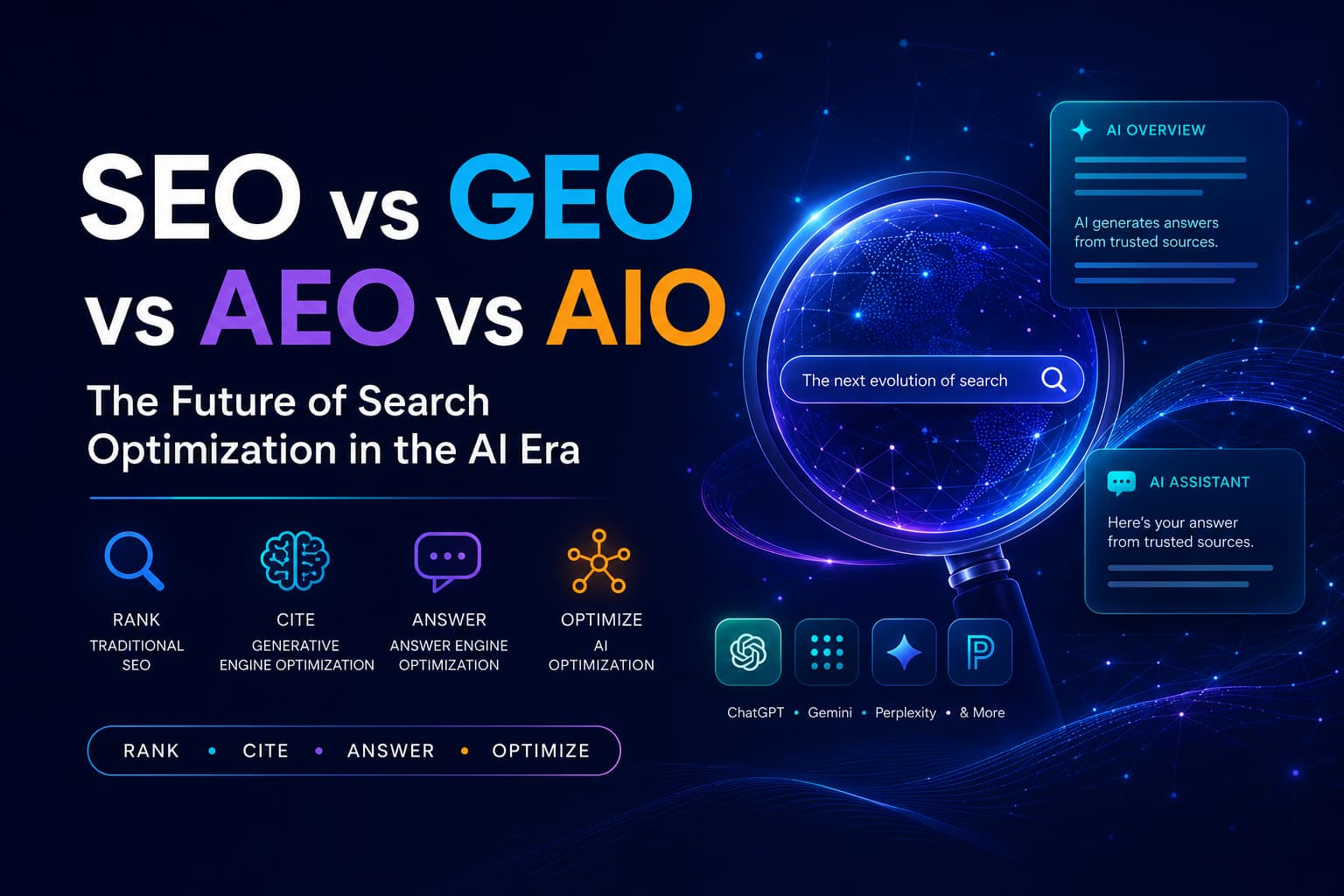
SEO vs GEO vs AEO vs AIO is becoming one of the most important conversations in modern digital marketing.
For more than two decades, digital visibility depended on one dominant interaction model:
A user typed keywords into a search engine, scanned blue links, clicked a website, and explored information manually.
That model is rapidly changing.
Today, users increasingly expect direct answers instead of search results. They ask questions conversationally. They rely on AI assistants to summarize complex topics. They trust recommendation engines more than traditional SERPs in many discovery journeys.
The rise of AI-powered search systems has fundamentally changed how information is discovered, interpreted, and surfaced online.
Platforms like:
- OpenAI
- Perplexity AI
- Anthropic
are reshaping search behavior through:
- Google AI Overviews
- conversational search
- synthesized AI answers
- zero-click experiences
- retrieval-augmented generation (RAG)
- multimodal discovery systems
Traditional SEO still matters. But it is no longer sufficient on its own.
A website can rank on page one and still lose visibility if AI systems summarize competitors instead.
A brand can dominate keywords yet remain invisible inside AI-generated recommendations.
A company can produce thousands of articles but fail to become a trusted entity inside generative search systems.
This is why new optimization disciplines are emerging:
- SEO (Search Engine Optimization)
- GEO (Generative Engine Optimization)
- AEO (Answer Engine Optimization)
- AIO (AI Optimization)
These are not interchangeable terms.
They represent different layers of visibility across modern search ecosystems.
And businesses that fail to understand the distinction risk losing discoverability in the next generation of search.
“The future of search is not about ranking pages. It is about becoming the source AI systems trust enough to cite, summarize, and recommend.”
This article breaks down exactly how SEO vs GEO vs AEO vs AIO works, what makes each approach different, and how businesses should adapt for the AI era.
What is SEO?
Defining Traditional SEO
Search Engine Optimization refers to the process of improving website visibility in traditional search engines like Google and Microsoft.
Historically, SEO focused on helping web pages rank higher for relevant keywords.
The traditional SEO ecosystem revolves around three major pillars:
1. On-Page SEO
This includes:
- keyword optimization
- title tags
- meta descriptions
- internal linking
- content structure
- semantic relevance
- heading hierarchy
Example:
A SaaS company targeting “CRM software for startups” creates a dedicated landing page optimized around that query.
2. Technical SEO
Technical SEO ensures search engines can crawl, index, and understand content efficiently.
This includes:
- site architecture
- page speed
- mobile optimization
- XML sitemaps
- canonicalization
- structured data
- Core Web Vitals
3. Off-Page SEO
This primarily involves:
- backlinks
- digital PR
- brand mentions
- authority signals
- domain trust
Google’s ranking systems historically relied heavily on backlink authority.
The Strength of Traditional SEO
SEO remains incredibly powerful because search intent still exists.
Users still search for:
- products
- services
- tutorials
- comparisons
- transactional information
Organic search continues to drive high-intent traffic with strong conversion potential.
For example:
- “best payroll software”
- “accounting software pricing”
- “cybersecurity SaaS comparison”
These queries still generate meaningful commercial traffic.
The Limitation of Traditional SEO in AI Search
The problem is that search behavior itself is evolving.
AI systems increasingly:
- summarize webpages
- synthesize multiple sources
- answer directly inside interfaces
- reduce clicks to publishers
- prioritize trusted entities over keyword-heavy pages
This creates several major shifts.
Zero-Click Search Expansion
Users often receive answers without visiting websites.
Google AI Overviews accelerate this trend.
Retrieval Over Ranking
AI systems care less about raw rankings and more about:
- contextual relevance
- semantic authority
- factual consistency
- citation trustworthiness
Entity-Based Understanding
Modern AI systems interpret concepts and relationships, not just keywords.
This means:
- topical authority matters more
- expertise matters more
- content depth matters more
- brand trust matters more
Traditional SEO optimized pages.
AI-first search optimizes knowledge.
What is GEO?
Understanding Generative Engine Optimization
Generative Engine Optimization (GEO) refers to optimizing content and brand visibility for AI-generated responses.
Instead of focusing purely on rankings, GEO focuses on becoming:
- cited
- referenced
- summarized
- retrieved
- recommended
inside generative AI systems.
This includes visibility in:
- ChatGPT
- Perplexity
- Gemini
- Claude
- AI search copilots
- retrieval-based assistants
How AI Search Systems Actually Work
Most modern AI search systems rely on some version of Retrieval-Augmented Generation (RAG).
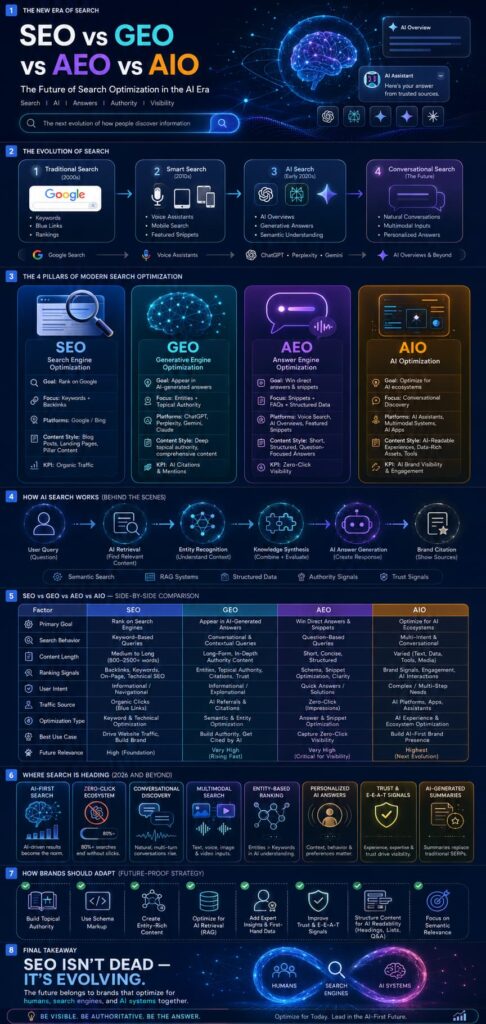
Simplified process:
- User asks a question
- AI retrieves relevant sources
- System evaluates authority and relevance
- AI synthesizes answers
- Final response is generated conversationally
This changes optimization dramatically.
The goal is no longer only:
“How do I rank #1?”
The new question becomes:
“How do I become a trusted source AI systems choose to reference?”
What GEO Prioritizes
Semantic Relevance
- AI systems interpret meaning, context, and topical relationships.
- A shallow keyword article may rank temporarily.
- But AI retrieval systems prefer comprehensive topical coverage.
Entity Authority
AI systems increasingly map entities instead of keywords.
Important entities include:
- brands
- people
- products
- concepts
- organizations
- technologies
Strong entity signals come from:
- digital PR
- citations
- Wikipedia-style references
- structured data
- authoritative mentions
- industry expertise
Structured Knowledge
AI systems favor information that is easy to parse.
This includes:
- tables
- FAQs
- definitions
- concise frameworks
- semantic headings
- schema markup
Citation-Worthy Content
AI assistants prefer content that appears:
- trustworthy
- factual
- original
- expert-driven
- well-structured
Generic AI-generated content often fails this test.
Practical GEO Strategies
Build Topical Authority Clusters
Instead of isolated blogs, create interconnected expertise ecosystems.
Example:
A cybersecurity company should own related topics like:
- endpoint protection
- zero trust security
- ransomware prevention
- SOC monitoring
- cloud threat detection
Optimize for AI Citations
AI systems often pull concise explanations.
Include:
- direct definitions
- concise summaries
- framework sections
- statistics
- comparison tables
Strengthen Entity Signals
Build consistent mentions across:
- industry publications
- podcasts
- review platforms
- research reports
- expert interviews
Create First-Hand Expertise
AI systems increasingly favor experience-rich content.
Strong GEO content includes:
- original research
- proprietary insights
- case studies
- unique frameworks
- real-world examples
GEO Example
Traditional SEO article:
“10 SEO Tips for Better Rankings”
GEO-optimized article:
“How AI Retrieval Systems Evaluate Content Authority in 2026”
The second article is more likely to:
- attract citations
- appear in AI summaries
- earn backlinks
- establish authority
What is AEO?
Understanding Answer Engine Optimization
Answer Engine Optimization focuses on optimizing content for direct answers.
This includes visibility in:
- featured snippets
- voice assistants
- AI summaries
- People Also Ask
- zero-click interfaces
- conversational assistants
AEO exists because users increasingly ask complete questions instead of typing fragmented keywords.
Example:
Instead of:
“best CRM”
Users ask:
“What is the best CRM for small SaaS startups under 50 employees?”
Why AEO Matters
Modern search engines increasingly prioritize:
- instant answers
- summarized information
- concise explanations
Google AI Overviews accelerate this trend.
Voice search also depends heavily on answer extraction.
Core AEO Strategies
Question-Based Content
Use natural language queries:
- What is GEO?
- How does AI search work?
- Why is schema markup important?
Concise Answer Blocks
Provide immediate answers within the first 40–60 words after a heading.
Example:
What is GEO?
Generative Engine Optimization (GEO) is the practice of optimizing content for AI-generated answers and retrieval systems rather than traditional search rankings alone.
That structure is highly AEO-friendly.
FAQ Optimization
Well-structured FAQs improve:
- snippet eligibility
- voice assistant retrieval
- conversational relevance
Schema Markup
Important schema types include:
- FAQ schema
- Organization schema
- Article schema
- HowTo schema
- Author schema
Structured data helps search systems interpret content accurately.
AEO-Friendly Formatting
Effective answer formatting includes:
- short paragraphs
- bullet points
- tables
- concise definitions
- semantic headings
Example of Strong AEO Structure
Bad:
A long, unstructured explanation buried inside paragraphs.
Better:
What is Perplexity Optimization?
Perplexity optimization refers to improving content visibility inside AI-generated search answers provided by Perplexity AI through semantic authority, structured information, and citation-worthy content formatting.
Then expand afterward.
What is AIO?
Understanding AI Optimization
Artificial Intelligence Optimization (AIO) is the broadest and most future-facing layer of modern search visibility.
AIO focuses on optimizing brand discoverability across AI ecosystems — not just search engines.
This includes:
- AI assistants
- recommendation systems
- conversational interfaces
- multimodal search
- predictive discovery
- AI copilots
- intelligent agents
AIO Goes Beyond Search
SEO optimized websites.
AIO optimizes digital presence across intelligent systems.
Future discovery may happen through:
- voice conversations
- AI shopping assistants
- autonomous agents
- wearable AI devices
- multimodal interfaces
- contextual recommendations
Core Components of AIO
Conversational Presence
Brands must become discoverable in conversational contexts.
Example:
“What is the best project management tool for remote product teams?”
AI systems synthesize recommendations from multiple sources.
Knowledge Graph Optimization
AI systems rely heavily on entity relationships.
Brands need:
- consistent identity signals
- structured data
- authoritative references
- trusted mentions
Multimodal Optimization
Future AI systems interpret:
- text
- audio
- video
- images
- documents
This means content diversification matters.
AI Memory Systems
- Emerging AI systems increasingly personalize recommendations.
- Brands that consistently establish authority may gain recurring visibility advantages.
Future AIO Strategies
Build Recognizable Expertise
Brands should aim to become category authorities.
Create Multi-Format Knowledge Assets
Include:
- articles
- videos
- podcasts
- research
- data studies
- expert commentary
Optimize for Conversational Discovery
Content should match how humans naturally ask questions.
SEO vs GEO vs AEO vs AIO
The Complete Comparison
| Factor | SEO | GEO | AEO | AIO |
| Primary Goal | Rank webpages | Get cited by AI | Provide direct answers | Become discoverable across AI ecosystems |
| Core Platforms | Google, Bing | ChatGPT, Perplexity, Gemini | Featured snippets, voice assistants | AI copilots, agents, assistants |
| Optimization Focus | Keywords + backlinks | Semantic authority | Answer formatting | AI ecosystem visibility |
| Content Style | Search-oriented | Citation-oriented | Concise answers | Conversational + multimodal |
| Key Signals | Rankings, links | Trust, entities, expertise | Snippet clarity | Brand intelligence |
| Traffic Model | Click-driven | Visibility-driven | Zero-click visibility | Recommendation-driven |
| User Behavior | Search and click | Ask and summarize | Ask and receive | Interact conversationally |
| Important Assets | Landing pages | Knowledge-rich content | FAQs and snippets | Entity ecosystems |
| KPI | Organic traffic | AI citations | Snippet ownership | AI recommendation visibility |
| Future Relevance | Still essential | Rapidly growing | Increasingly important | Long-term strategic layer |
Which Businesses Should Prioritize Which Strategy?
SaaS Companies
Prioritize:
- SEO
- GEO
- AEO
because B2B buyers increasingly use AI tools during research.
Local Businesses
AEO becomes extremely important due to:
- voice search
- local AI summaries
- direct-answer discovery
Enterprise Brands
Need full integration across:
- SEO
- GEO
- AEO
- AIO
because large brands compete inside complex AI ecosystems.
Why Integration Matters
Modern search visibility is no longer linear.
A single user journey may involve:
- Google search
- AI Overview
- ChatGPT research
- YouTube validation
- Reddit discussion
- Voice assistant confirmation
Visibility must exist across all layers.
How Search is Evolving in 2026
The Decline of Blue-Link Dominance
Traditional SERPs are becoming interface layers for AI-generated answers.
Search engines increasingly behave like:
- research assistants
- answer engines
- recommendation systems
Conversational Search is Becoming Normal
Users are moving toward natural-language interactions.
Example:
Old search:
“best accounting software”
Modern AI search:
“What accounting software works best for multi-location retail businesses with GST compliance?”
That shift changes optimization dramatically
Zero-Click Ecosystems Will Expand
Many users will never visit websites directly.
AI systems increasingly satisfy informational intent inside interfaces.
This creates pressure on publishers to:
- become citation sources
- strengthen brand authority
- optimize beyond clicks
E-E-A-T is Becoming More Important
E-E-A-T now extends beyond traditional SEO.
AI systems increasingly evaluate:
- expertise
- experience
- trust
- authority
- factual consistency
Thin content loses visibility faster in AI systems.
Retrieval-Augmented Generation (RAG) Will Dominate
Retrieval-Augmented Generation combines:
- retrieval systems
- vector search
- semantic ranking
- generative AI
This means future optimization depends heavily on:
- semantic clarity
- entity relationships
- trustworthy information
Multimodal Search Will Expand
Future search systems increasingly interpret:
- images
- video
- audio
- screenshots
- documents
Text-only strategies will become insufficient.
Future-Proof Optimization Framework
The AI-Era Search Visibility Framework
1. Build Entity-Rich Content
Content should establish:
- people
- products
- brands
- technologies
- concepts
as recognizable entities.
2. Create Topical Authority Maps
Instead of publishing random blogs:
Build interconnected content ecosystems.
Example cluster:
- AI SEO
- AI retrieval systems
- semantic search
- AI Overviews
- GEO strategy
- entity optimization
3. Use Structured Formatting
AI systems prefer clarity.
Use:
- FAQs
- tables
- bullet points
- definitions
- semantic headings
4. Strengthen Trust Signals
Include:
- expert authorship
- citations
- research
- statistics
- case studies
- first-hand expertise
5. Implement Schema Markup
Prioritize:
- Article schema
- FAQ schema
- Organization schema
- Author schema
6. Optimize for Conversational Queries
Match natural-language intent.
Example:
Instead of:
“AI SEO tools”
Target:
“Which AI SEO tools help improve AI Overview visibility?”
7. Invest in Digital PR
AI systems trust brands that are consistently referenced across the web.
Tactical Checklist
GEO Checklist
- Build topical depth
- Add semantic relationships
- Create citation-worthy insights
- Publish original research
- Improve entity recognition
AEO Checklist
- Add FAQ sections
- Use concise answers
- Implement schema
- Optimize snippets
- Structure headings clearly
AIO Checklist
- Build multi-format authority
- Strengthen brand mentions
- Create conversational assets
- Expand multimedia visibility
- Optimize knowledge graphs
Common Mistakes to Avoid
1. Over-Reliance on Keywords
- Keyword density alone is no longer enough.
- Semantic understanding now matters more.
2. Publishing Thin AI-Generated Content
- Mass-produced low-value content weakens authority.
- AI systems increasingly identify shallow information patterns.
3. Ignoring Entity Signals
Without entity authority, brands struggle to appear in AI-generated answers.
4. Weak E-E-A-T Signals
Anonymous content with no expertise signals loses trust rapidly.
5. Treating GEO as “SEO with a New Name”
- GEO changes optimization philosophy.
- The goal shifts from rankings to trusted retrieval.
6. Publishing Without Topical Depth
- One-off articles rarely build authority anymore.
- Topic ecosystems matter more.
7. Ignoring Structured Data
- Schema helps machines interpret content efficiently.
- This becomes even more important in AI retrieval systems.
Final Verdict
Is SEO Dead?
No.
But SEO is evolving into something much broader.
Traditional SEO still drives:
- organic discovery
- commercial intent traffic
- transactional visibility
However, rankings alone are no longer enough.
Which Strategy Matters Most?
There is no single winner.
The future belongs to integrated optimization.
SEO gives discoverability.
GEO gives AI citations.
AEO gives answer visibility.
AIO gives ecosystem presence.
Businesses that combine all four create durable visibility advantages.
What Should Companies Prioritize Today?
Immediate Priorities
- strengthen topical authority
- improve semantic structure
- optimize for AI retrieval
- build trusted entity signals
- create expert-driven content
Strategic Priorities
- diversify beyond search traffic
- invest in brand authority
- optimize for conversational discovery
- build AI-readable knowledge ecosystems
The Real Future of Search
The next era of search will not belong to brands that publish the most content.
It will belong to brands that become the most trusted sources of knowledge.
AI systems increasingly reward:
- credibility
- expertise
- structure
- semantic depth
- factual consistency
- authority
The future of search optimization is not just about being found.
It is about being understood, trusted, and recommended by intelligent systems.
Frequently Asked Questions (FAQ) – SEO vs GEO vs AEO vs AIO
What is Generative Engine Optimization (GEO)?
Generative Engine Optimization (GEO) is the process of optimizing content for AI-powered search systems that generate answers instead of only displaying traditional search results. GEO focuses on improving visibility in platforms like ChatGPT, Perplexity, Gemini, and AI Overviews by making content semantically rich, authoritative, structured, and citation-worthy.
How is GEO different from traditional SEO
Traditional SEO focuses on improving rankings in search engine results pages through keywords, backlinks, technical SEO, and on-page optimization. GEO focuses on helping AI systems retrieve, understand, and cite content in generated responses.
What is Answer Engine Optimization (AEO)?
Answer Engine Optimization (AEO) is the practice of structuring content so search engines and AI systems can easily extract direct answers for users. AEO improves visibility in featured snippets, voice search, AI summaries, and zero-click search results by using concise answers, FAQs, schema markup, and structured formatting.
Why is AI search optimization important in 2026?
AI search optimization is important because search behavior is rapidly shifting toward AI-generated answers, conversational interfaces, and zero-click experiences. Platforms like ChatGPT, Gemini, Perplexity, and Google AI Overviews are changing how users discover information. Businesses that optimize only for traditional SEO risk losing visibility inside AI-driven search ecosystems.
How do ChatGPT and Perplexity retrieve information?
Platforms like ChatGPT and Perplexity AI often use Retrieval-Augmented Generation (RAG) systems. These systems retrieve relevant information from trusted sources, evaluate semantic relevance and authority, then synthesize answers conversationally. They prioritize structured, authoritative, entity-rich, and trustworthy content.
Is SEO still relevant in the AI era?
Yes, Search Engine Optimization is still highly relevant. Traditional SEO remains essential for organic discovery, indexing, and transactional search traffic. However, modern search visibility now also requires GEO, AEO, and AI optimization strategies to improve visibility inside AI-generated answers and conversational search systems.
What are Google AI Overviews?
Google AI Overviews are AI-generated summaries that appear directly in Google search results. These summaries combine information from multiple sources to answer user queries instantly. AI Overviews increase zero-click searches and shift visibility from simple rankings toward AI citation and authority optimization.
How can businesses optimize for AI-generated answers?
Businesses can optimize for AI-generated answers by:
building topical authority
creating entity-rich content
using schema markup
structuring content clearly
publishing expert-driven insights
improving semantic relevance
adding FAQs and concise summaries
strengthening trust and E-E-A-T signals
earning authoritative mentions and citations
AI systems prioritize trustworthy, well-structured, and contextually relevant content.
What is the difference between GEO and AEO?
GEO focuses on improving visibility inside AI-generated answers by building semantic authority and entity relevance. AEO focuses on helping search engines extract concise direct answers for snippets, voice search, and zero-click search experiences.